
Designing and constructing a car park is a major investment for property developers, real estate investors, and civil engineers. The surface you choose — concrete or asphalt — will influence not only the aesthetics and functionality of your car park but also its long-term performance, maintenance needs, and overall cost.
In Melbourne’s climate, where temperature fluctuations and heavy traffic are common, the right decision requires balancing durability, cost, and purpose. This guide highlights the main factors to consider when choosing between concrete and asphalt for your upcoming car park construction project.
Understanding the Two Materials
Concrete Car Park Construction in Melbourne
Concrete is a rigid, long-lasting material made from cement, water, sand, and aggregates. It is widely used in commercial car park construction because of its strength and resistance to deformation.
A civil construction company in Melbourne will often recommend concrete for large-scale or high-traffic sites — such as shopping centres, industrial estates, and apartment complexes — where load-bearing capacity and minimal maintenance are essential.
Advantages:
- Exceptional load-bearing strength
- Long lifespan (20–40 years or more)
- Resistant to oil spills, fuel leaks, and UV rays
- Bright surface improves visibility and reduces lighting costs
Disadvantages:
- Higher initial installation cost
- Longer curing time before use
- Repairs can be more complex
Asphalt Car Park Construction in Melbourne
Asphalt is a flexible pavement material made from aggregates bound together by bitumen. It is commonly used for commercial car parks, driveways, and roadways because of its smooth finish and cost efficiency.
Many asphalt contractors in Melbourne prefer it for projects that demand quick installation and a lower upfront investment.
Advantages:
- Lower installation cost
- Faster construction and curing time
- Easy and affordable maintenance
- Quiet and smooth driving experience
Disadvantages:
- Shorter lifespan (10–20 years on average)
- Can soften or deform in extreme heat
- Requires periodic resurfacing
Installation Process and Time
Concrete Construction Services in Melbourne
Concrete surfaces take more time to install due to site preparation, formwork, pouring, and curing. A standard car park contractor will require 5–10 days for a medium-sized project, depending on the complexity and weather.
However, once cured, concrete surfaces provide a solid, permanent foundation that needs minimal maintenance. They are ideal for construction project management teams focusing on longevity and reduced lifecycle costs.
Asphalt Services in Melbourne
Asphalt installation is quicker and can often be completed within 1–3 days. The surface cools rapidly, allowing vehicles to use the car park almost immediately.
For developers and civil engineers managing time-sensitive projects, asphalt offers significant schedule advantages, particularly when fast handover or minimal downtime is a priority.
Cost Comparison: Short-Term vs Long-Term
Initial Cost
- Asphalt: Typically cheaper to install. The average cost in Melbourne ranges between $35–$55 per square metre, depending on thickness and preparation.
- Concrete: Costs more upfront, averaging $70–$100 per square metre.
Maintenance Cost
- Asphalt: Requires resealing every 3–5 years to prevent cracking and water penetration. Over time, maintenance adds up.
- Concrete: Needs minimal upkeep — usually just occasional cleaning and joint sealing.
Lifecycle Cost
When viewed over 20 years, concrete may prove more economical. Although asphalt services in Melbourne are budget-friendly upfront, concrete car park construction offers savings through reduced repairs and a longer lifespan.

Durability and Lifespan
Concrete stands out for its strength and durability, making it ideal for supporting heavy loads and frequent traffic. It resists deformation from static loads (such as parked trucks) and stands firm against fuel, oil, and chemical exposure.
Asphalt, being flexible, handles dynamic loads better — making it suitable for high-traffic areas with continuous vehicle movement. However, Melbourne’s varying temperatures can cause expansion and contraction in asphalt surfaces, leading to cracks if not maintained.
In summary:
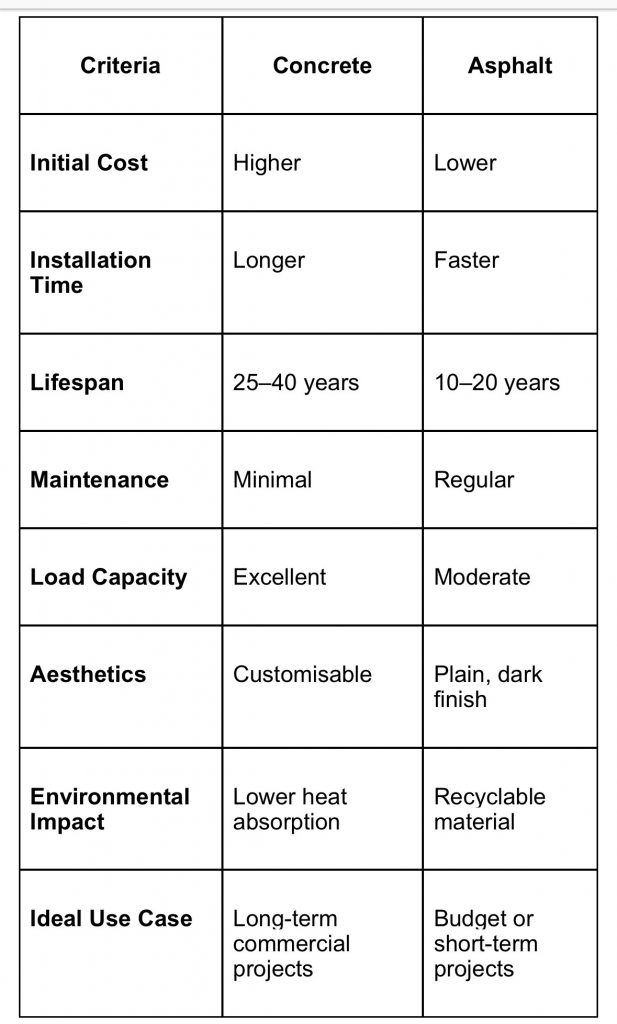
- Concrete: Lifespan 25–40 years
- Asphalt: Lifespan 10–20 years
For developers managing long-term property investments, concrete offers better value. For projects with budget or time constraints, asphalt remains a reliable short-term choice.
Aesthetics and Safety
Concrete
Concrete surfaces offer a brighter finish that reflects light effectively, improving visibility and ensuring safer conditions for drivers and pedestrians. This reduces the need for additional lighting and improves security in car parking construction projects.
Additionally, concrete allows for textured or decorative finishes that align with architectural aesthetics — ideal for shopping centres or premium office developments.
Asphalt
Asphalt’s dark surface gives a clean, uniform appearance that hides stains well. Line markings appear crisp, which is essential for defining parking bays and traffic flow. However, over time, oxidation may fade the surface to a dull grey.
For visual impact and branding consistency, many car park contractors in Melbourne combine the two materials — using asphalt for drive lanes and concrete for high-load or decorative zones.
Climate Suitability in Melbourne
Melbourne’s climate presents unique challenges for construction — fluctuating temperatures, rainfall, and occasional heatwaves.
- Concrete: Performs better in extreme heat and is less likely to soften or rut. However, expansion joints must be properly designed to prevent cracking during cold snaps.
- Asphalt: It expands and contracts with temperature fluctuations, which can lead to surface distortion if not properly sealed. Using polymer-modified bitumen can improve its performance in Melbourne’s weather conditions.
Choosing the right civil construction company in Melbourne ensures materials and designs are tailored to local environmental conditions.
Maintenance and Repair
Concrete Maintenance
Concrete requires periodic cleaning, sealing of joints, and prompt repair of any cracks to prevent water ingress. When properly maintained, it can serve decades without resurfacing.
Asphalt Maintenance
Asphalt demands more frequent care. Regular sealing, patching, and occasional resurfacing are essential to extend its life. The advantage, however, lies in the simplicity — most repairs can be completed overnight with minimal disruption to car park operations.
For construction project management teams, asphalt’s maintenance flexibility makes it easier to schedule works around business operations.
Environmental Impact
Concrete and asphalt each have different environmental footprints.
- Concrete: Produces more CO₂ during manufacturing but reflects heat, reducing urban heat island effects. It also requires less energy for lighting due to its brightness.
- Asphalt: Uses bitumen — a petroleum product — but can be recycled efficiently. Reclaimed asphalt pavement (RAP) can be reused in new surfaces, reducing waste.
A civil construction company in Melbourne may combine both materials to balance sustainability, cost, and performance goals.
Customisation and Design Flexibility
Concrete offers more design possibilities, including decorative finishes, coloured aggregates, and stamped textures. It’s ideal for projects that value aesthetics — such as shopping precincts or luxury apartment complexes.
Asphalt, while limited in appearance, excels in functionality. Its flexibility allows easier grading for water drainage and quick integration with existing roadways or footpaths.
Experienced car park contractors can also blend both materials — for example, using asphalt in drive lanes for flexibility and concrete in parking bays for strength and cleanliness.
Choosing the Right Car Park Contractor
Your project’s success depends on partnering with the right car park contractor in Melbourne. Look for companies with:
- Proven experience in both concrete and asphalt applications
- In-house construction project management expertise
- Knowledge of local council regulations and DDA compliance
- Ability to offer concrete construction services and asphalt services under one contract
This ensures consistent quality, faster project delivery, and a single point of accountability.
When to Choose Concrete
Concrete is the preferred choice when:
- The car park will serve heavy vehicles or long-term parking
- The design requires decorative finishes or colour consistency
- Low maintenance and long-term durability are priorities
- The site demands excellent reflectivity and visibility
Typical examples:
- Industrial complexes
- Multi-storey car parks
- Retail centres
- Institutional or hospital car parks
When to Choose Asphalt
Asphalt is ideal when:
- The project requires fast completion
- The budget is limited
- The surface will experience lighter loads or frequent resurfacing cycles
- Flexibility for future expansion or modification is important
Common applications:
- Temporary or overflow parking areas
- Small commercial premises
- Schools and recreational facilities
- Drive lanes within large car parks
The Hybrid Approach: Best of Both Worlds
Many developers in Melbourne now prefer hybrid car park construction, combining the strengths of both materials.
For example:
- Concrete for entrances, loading bays, and pedestrian zones
- Asphalt for internal driveways and general parking spaces
This strategy balances cost, appearance, and performance — delivering the most value for long-term property investments.
The Role of Construction Project Management
Effective construction project management ensures your car park meets both functional and financial goals. A professional civil construction company in Melbourne manages every phase — from design to material selection, drainage planning, and compliance checks — while coordinating contractors for concrete and asphalt works.
The result is a durable, compliant, and visually appealing car park that enhances property value.
Final Decision: What’s Right for Your Project?
Ultimately, the right surface depends on your project’s purpose, budget, and long-term vision.
Conclusion
Whether you choose concrete car park construction in Melbourne or opt for asphalt services, the goal remains the same — a safe, durable, and cost-effective surface that supports your property’s value and usability.
By working with a reliable car park contractor and an experienced civil construction company in Melbourne, you can strike the ideal balance between practicality, appearance, and long-term return on investment.
Each material has its place. Concrete ensures strength and longevity, while asphalt offers flexibility and affordability. The best choice is the one that fits your project timeline, budget, and performance goals — guided by expert construction project management.